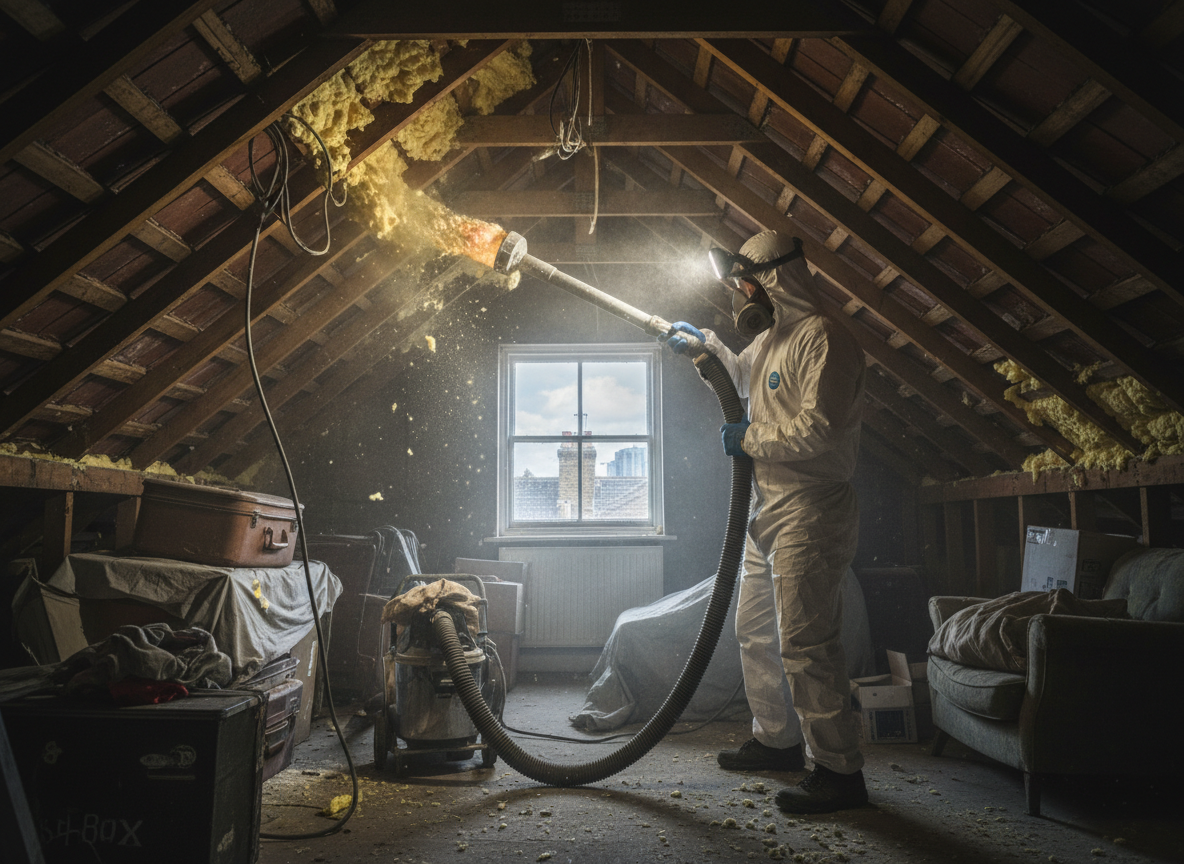
London’s Victorian and Edwardian terraces often feature pitched roofs with limited ventilation, where closed-cell spray foam was applied directly to rafters in the 2000s and 2010s. Over time the foam traps condensation from the city’s frequent rain and mild winters, leading to timber decay that remains hidden until removal begins. Crews working from 197 Kensington High St routinely encounter bitumen felt under the foam that has deteriorated, requiring careful separation to avoid damaging the roof covering during extraction.
Removal in these properties demands negative-pressure containment because dust and foam particles can migrate through shared chimney breasts and party walls common in terraces. Technicians cut the foam into manageable sections rather than scraping, reducing the risk of puncturing the roof membrane. Disposal follows Greater London Authority rules for construction waste, with loads taken to licensed sites rather than general landfill.
Edge cases include listed buildings in Kensington and Chelsea where listed-building consent may be needed before disturbing original roof structures. In post-war estates further out in zones like Ealing or Croydon, open-cell foam was sometimes used over ceilings, creating different dust profiles and requiring extra protection for electrical cabling that runs through the insulation layer.
Technician insight
In London, the thing that catches most people out with Attic spray foam removal is how Victorian terraces channel rainwater along shared gutters straight into the loft space once the foam is stripped; the damp winters here mean any missed rot on the rafters shows up weeks later if you don’t ventilate properly straight away.
Kensington Terrace Loft
Homeowner reported persistent musty smell in a top-floor flat. Inspection revealed closed-cell foam trapping moisture against 1890s rafters. Crew removed the foam in sections, exposed wet felt and early rot, then improved ridge ventilation. The loft dried out without further timber replacement.
How it works
- 1
Site Assessment
Inspect attic access, roof condition, and any signs of moisture or rot before work starts.
- 2
Containment Setup
Install negative-pressure barriers and floor protection to keep dust from spreading through the property.
- 3
Foam Extraction
Cut and remove foam in sections, checking rafters and felt for hidden damage as work progresses.
- 4
Final Clearance
Vacuum residues, remove containment, and advise on ventilation improvements to prevent recurrence.
Pricing
Pricing varies by attic size, foam depth and access difficulty; upfront quotes issued after inspection.