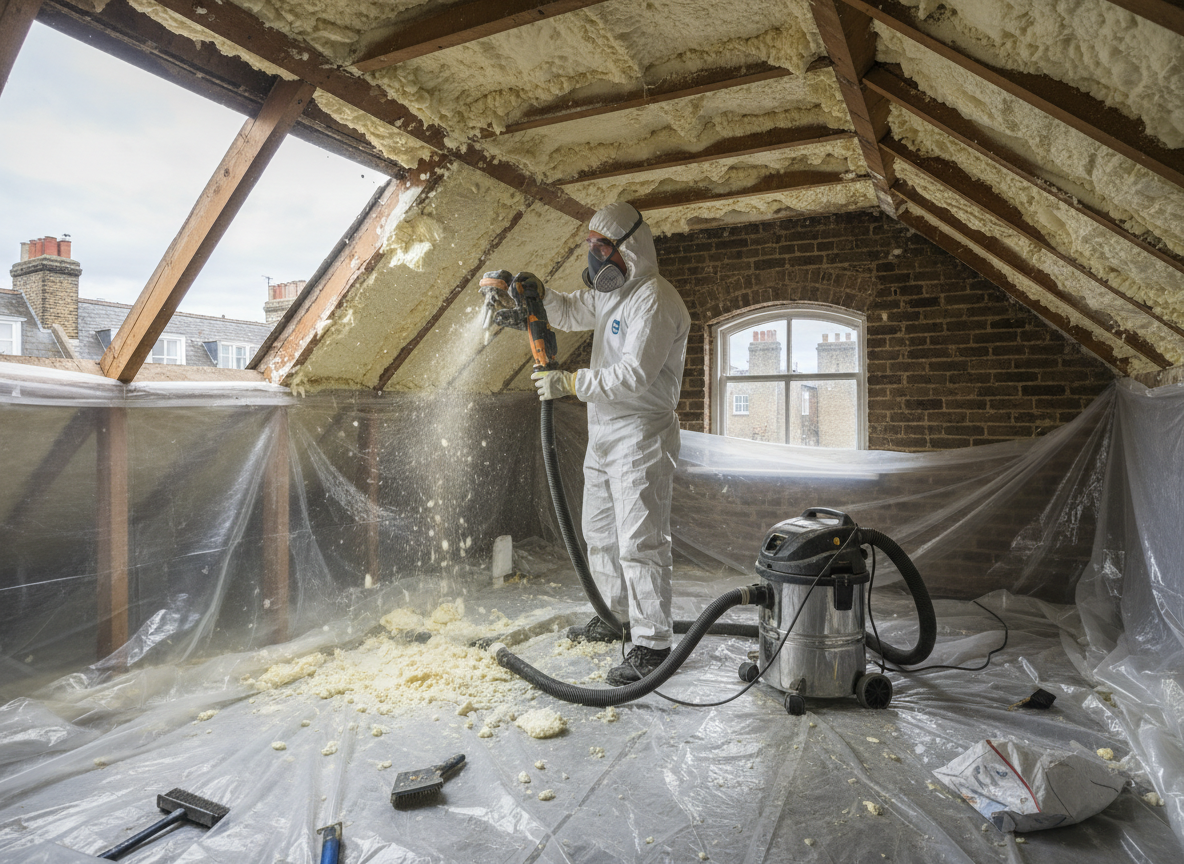
London's Victorian and Edwardian terraces in neighborhoods like Kensington and Notting Hill often have lofts insulated with spray foam that traps moisture against original timber and slate roofs. Removing it requires careful cutting around rafters and ventilation gaps that were never designed for modern closed-cell products. Crews must also check for hidden lath and plaster ceilings below that can collapse if foam expands during extraction.
Damp winters in the London area mean foam in lofts frequently shows black mould growth where it meets the roof felt. Extraction teams work section by section to avoid spreading spores into living spaces below, using negative air machines vented through existing chimney stacks common in these streets. Older properties around Hyde Park also have narrow loft hatches that limit equipment size and force more manual removal.
Building regulations in Greater London require any new insulation after removal to meet current ventilation standards, so crews document the original roof void airflow before starting. In areas with clay soil like parts of Fulham, minor roof movement can crack foam bonds, making full removal slower than in newer stock. Homeowners in these terraces frequently discover the foam was applied over existing mineral wool, doubling the waste volume.
Access through Kensington mews and narrow side streets affects how equipment reaches the property, often requiring smaller vans and hand-carrying bags of removed foam. The work is scheduled around the frequent rain that can enter once the loft is opened, so tarpaulins and temporary ridge vents are standard on every job.
Technician insight
In London, the thing that catches most people out with loft spray foam removal is the narrow hatches and hidden lath-and-plaster ceilings in Victorian terraces around Kensington and Chelsea. Once you start cutting foam the ceiling below can crack if the original plaster keys are already weak, and the frequent rain means you have to keep the roof covered the whole time you're working.
Kensington Terrace Loft Clearance
Homeowner in a 1890s Kensington terrace noticed damp patches on bedroom ceilings after spray foam had been applied years earlier. Inspection showed closed-cell foam blocking all eaves ventilation and trapping condensation against the rafters. The crew cut the foam into manageable blocks, extracted it through the existing loft hatch, and restored airflow while protecting the original plasterwork below. The loft now meets current ventilation standards without further damage to the roof structure.
How it works
- 1
Initial Loft Inspection
Assess foam type, thickness, roof condition and access points in properties across London.
- 2
Containment Setup
Install dust barriers and negative air filtration to protect living areas below the loft.
- 3
Foam Extraction
Cut and remove spray foam in sections, clearing rafters and ventilation paths without damaging original timbers.
- 4
Waste Removal and Clean
Bag all material, vacuum residual dust and check for remaining insulation or mould.
- 5
Final Ventilation Check
Confirm roof void airflow meets current standards before handing back the space.
Pricing
Cost depends on loft size, foam depth and access difficulty in older London terraces; site visit required for accurate quote.