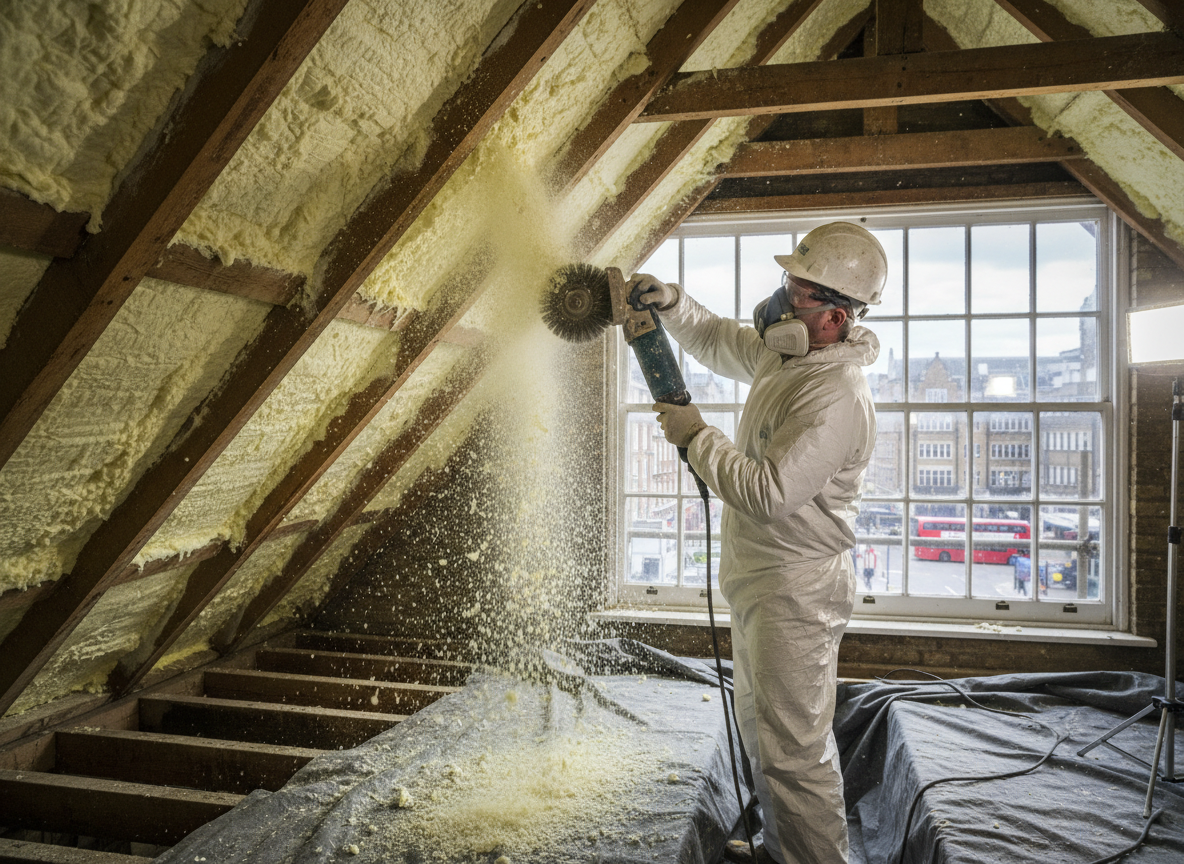
London’s Victorian and Edwardian terraces in Kensington and Chelsea often received closed-cell spray foam on pitched roofs decades ago to improve insulation. Over time the foam traps moisture against original timber rafters and slate or tile coverings, especially during the city’s frequent autumn and winter rainfall. Removing it requires careful cutting and scraping without damaging historic lath and plaster ceilings below or disturbing party-wall junctions common in these tightly packed streets.
Weather patterns in Greater London add complexity: mild but persistently damp conditions mean the foam can remain saturated for weeks, increasing weight and adhesion. Crews must set up full containment to prevent debris falling onto pavements or neighbouring gardens, and work is frequently scheduled around early mornings or evenings to minimise disruption in busy residential squares. Older roofs also feature irregular rafter spacing and hidden lead flashings that demand hand-tool precision rather than power equipment.
Disposal follows strict Environment Agency rules for construction waste generated in the capital. Removed foam sections are bagged on site, weighed, and taken to licensed facilities rather than general landfill. Homeowners in areas such as Notting Hill or Fulham frequently discover that partial removal leaves cold spots and condensation risks, so complete extraction followed by proper ventilation upgrades is usually required to restore the roof’s original performance.
Access challenges arise from narrow mews and shared access ways behind Kensington High Street properties. Ladders and debris chutes must be positioned to avoid street trees protected by local conservation orders, and work often proceeds section by section to keep the roof weather-tight overnight.
Technician insight
In London, the thing that catches most people out with roof spray foam removal is how Victorian terraces in Kensington share rooflines and party walls, so any moisture trapped behind the foam quickly migrates into the neighbour’s loft and turns a single-house job into a coordinated two-property project.
Kensington Terrace Roof
Homeowner noticed persistent loft damp in a 1890s terrace off Kensington High Street. Inspection revealed closed-cell foam fully covering rafters and trapping rainwater against shared timbers. We removed the foam section by section under full containment, dried the exposed structure, and cleared all waste the same day, restoring ventilation without affecting the neighbouring property.
How it works
- 1
Initial Roof Assessment
Inspect the property from loft and exterior to map foam coverage, note rafter condition, and identify any shared roof elements with neighbouring homes.
- 2
Containment Setup
Install internal dust barriers and external sheeting to protect interiors, gardens, and adjacent pavements before any cutting begins.
- 3
Foam Extraction
Cut and peel foam in manageable sections using hand tools, working from ridge down to eaves while monitoring for hidden timber decay.
- 4
Site Clearance and Disposal
Bag all material, remove containment, and transport waste to licensed London facilities, then perform final loft inspection.
Pricing
Pricing depends on roof size, foam thickness, and access constraints; upfront quotes issued after inspection.