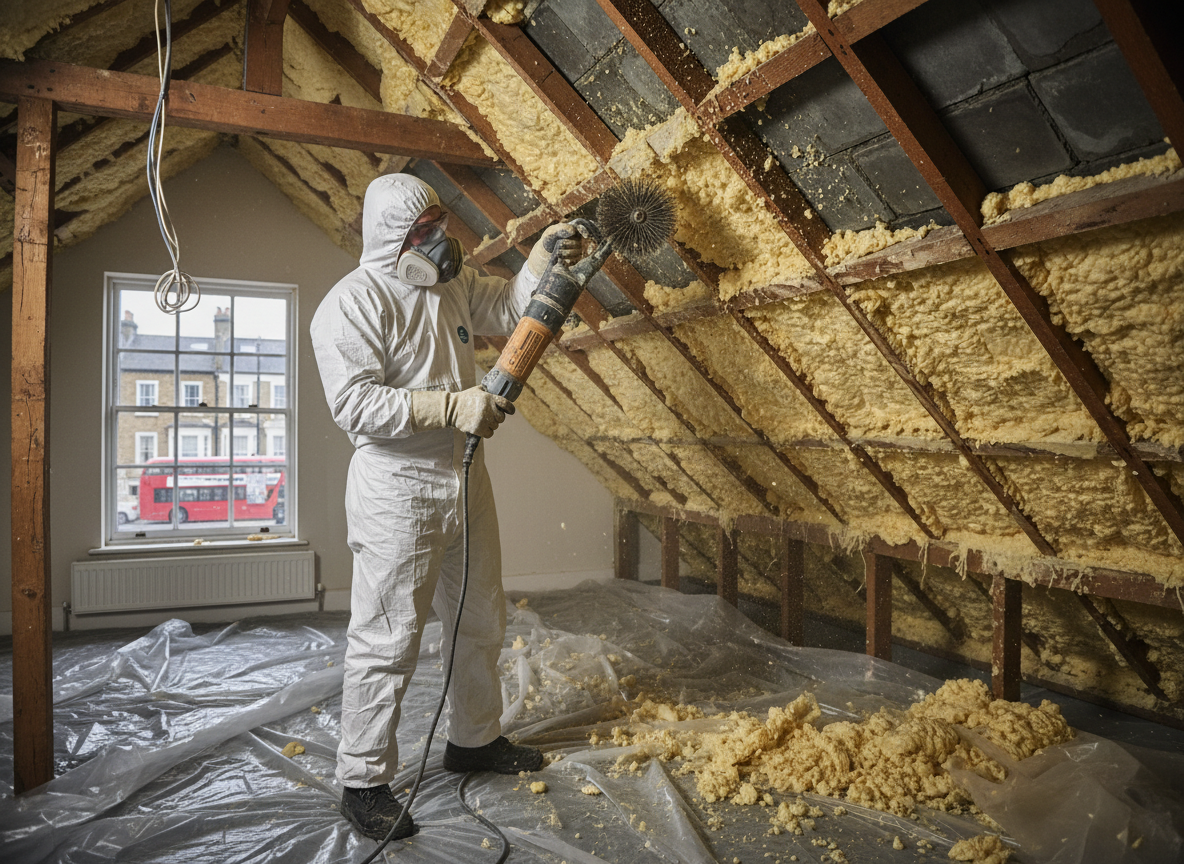
London's Victorian and Edwardian terraces in areas like Kensington and Notting Hill often received spray foam in lofts during energy upgrades of the last two decades. The closed-cell material bonds tightly to rafters and lath, trapping moisture against original timbers that were never designed for sealed conditions. Removal requires cutting back to the original roof structure while protecting historic plaster ceilings below, a step that becomes more delicate in narrow mews houses where access is limited to internal hatches.
Damp winters and frequent rainfall in the London basin mean many properties already carry hidden rot once the foam is peeled away. Crews must inspect for wet rot along ridge boards and purlins before any new insulation goes in, especially in properties built before 1919 where breathable materials were standard. Failure to address this during extraction leaves homeowners facing recurring leaks once the roof is re-covered.
Post-war council blocks and 1960s semis across Greater London present different challenges. Foam was sometimes applied directly over concrete soffits or in cavity walls, requiring dust containment and careful separation from electrical runs that were never intended to be buried. Each job starts with a full loft survey to map pipes, cables and any asbestos remnants common in that era before mechanical removal begins.
Technician insight
In London, the thing that catches most people out with spray foam insulation removal is hidden wet rot along rafters in pre-1919 terraces around Kensington where the foam sealed in decades of roof leaks that never dried out.
Kensington Terrace Loft Extraction
Foam had been sprayed over rafters in a narrow Victorian terrace off Kensington High Street. We found active wet rot along the ridge once the material was cut back. After removal and timber treatment the owner could schedule proper roof repairs without further hidden damage.
How it works
- 1
Initial Survey And Access
Inspect loft or wall cavities from the address in Kensington or surrounding boroughs, identify foam type and any hidden services.
- 2
Containment Setup
Seal work zones with sheeting to protect original features and prevent dust migration into living spaces.
- 3
Mechanical Removal
Cut and peel foam in sections, bagging waste immediately while checking rafters for decay.
- 4
Final Clearance And Report
Vacuum residues, photograph exposed timbers and provide written findings for the homeowner.
Pricing
Cost depends on property age, foam depth and access difficulty; upfront quotes provided after survey.